preloader
Agata Nowosielska
     

Aneta Szyłak-tekst do wystawy Opera Bizarna w Trafostacji Sztuki w Szczecinie, kurator: Stanisław Ruksza (2023)

Read english version below

Bad dreams in the night
They told me I was going to lose the fight
Leave behind my wuthering, wuthering
Wuthering Heights

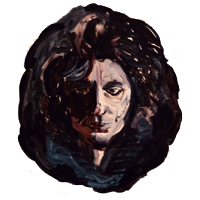
Patrzę na twarze malowane przez Agatę Nowosielską, a w głowie mam przebitki ze śpiewającą Kate Bush, przekraczającą swoją cielesną ekspresją, twarzą i głosem konwencje sceniczne pop-kultury. To dziwaczność doprowadzona do ekstremum, oczy o woli własnej i ciało w konwulsji. Taniec ptaka trzepoczącego się na uwięzi. Ośmieszająca własną urodę, wyzwalająca się z niej, Bush przedkłada bliskość emocjonalną między twarzą a umysłem nad tkliwą pielęgnację wizerunku. Jej ruchy są niespodziewane, pozbawione ładności, harmonii i spójnej choreografii. Także twarze malowane przez Nowosielską multiplikują się i walczą o widoczność dla swojej inności. Nie ma w nich niczego wystudiowanego, są niczym złapane w momencie, gdy nikt nie patrzy. Może też – gdy bardzo się chce, żeby nikt nie patrzył. To odmieńcy, postaci przerażające lub przerażone, twarze, które chcemy ukryć. Toczy się tu zażarta walka pomiędzy światem reprezentowanym a światem skrywanym. Nowosielska lansuje odmieńca, skrytego i zanoszącego się raz śmiechem, raz łkaniem.

Osobiście mam jakiś rodzaj dystansu do słowa „bizarność” w tytule wystawy; może zwykła „dziwaczność” brzmiałaby bardziej swojsko, ale to już się stało, więc skupmy się na tej historii o dziwolągach i wizjach. Dziwaczność jest tu tropem głównym, narzędziem dissującym kulturę opartą na pięknie i zdrowiu, w której wizerunek określonego typu ma gwarantować rzekomo wszystko, co uważane jest za szczęście – ale też dziwaczność ta zwalcza lęk śmiechem. Nie bez przyczyny prace na wystawie to poniekąd także emocjonalna historia pandemii, w trakcie której powstawała większość pokazywanych obrazów. Służy temu wieloosobowa mieszanka stylów, szczególnie widoczna, gdy w mniejszej sali na piętrze przyglądamy się chmurom ułożonym w kątach pomieszczenia. Są to częściowo materiały wyjściowe do obrazów, ale też alternatywna opowieść o sposobach obrazowania, o wizualnych przyzwyczajeniach. Szkice i notacje w formie kolaży tasujących rozmaite formy przedstawienia są dla Nowosielskiej praktyką równoległą, czasami przecinającą się z malarstwem, ale też całkowicie osobną, gdy jej dynamiczne malarstwo zastępują kolekcje cudzych obrazów uporządkowanych dla własnej potrzeby. W końcu musimy się też uporać z ich nadprodukcją i umieć ją odeprzeć.

Stanisław Ruksza przygotował wystawę Nowosielskiej w niełatwej – dla malarstwa i nie tylko – przestrzeni Trafostacji Sztuki: industrialnej, dominującej, zakłócanej szklanymi taflami w podłodze. Dzięki specyficznemu ustawieniu, odbicia obrazów w szklanych i lustrzanych powierzchniach multiplikują wystawę tak, że staje się – zgodnie z tytułem –„operą”, dziełem totalnym, w którym dziwnie obsesyjne, czasem ironiczne, czasem przerażające i pełne lęku obrazu tworzą przejmującą kakofonię. W większości rozstawione są niejako w poprzek różnych serii i tematów, układają się w opowieść właśnie dziwaczną, będącą bardziej instalacją malarską, akumulacją przedstawień i ich zakłóceń. Równouprawnione w obrazach są postaci i przedmioty, wnętrza i rośliny. Łączy je rodzaj splątania, w którym cieniutkie nitki farby tworzą pajęczynę, owijając to, co przedstawione, w kokon, mgłę, tak jakby zamykały się za nimi warstwy pamięci.

Jest więc ta ekspresja Kate Bush widoczna w bardzo mokrym, rozlewnym malowaniu. Te obrazy wcale nie chcą się podobać, zapatrzone w swój własny mrok. Twarze są wykrzywione, przerażone, zdumione, ale nie wiemy, czy to naprawdę, czy tylko się przedrzeźnia. To wojna wydana lękowi, który pokonać można ironią, złośliwym śmiechem i determinacją pozostania w odmienności. Wiele z obrazów wygląda jak scena w mroku, gdy nie wiemy, czy to, co widzimy to przedmioty czy postaci; być może to coś pomiędzy, co jest gotowe w każdej chwili znaleźć nową, być może przerażającą, być może komiczną formę. Najciekawsze w twórczości Nowosielskiej jest to, że jej w większości mroczne, niespokojne obrazy malowane są z niesłychaną energią i radością. Nowosielska maluje dość „mokro”, swobodnymi i energicznymi ruchami. Większość obrazów jest bardzo dynamiczna, możemy tu pójść tropem gestów i spontanicznych decyzji. Malarstwo zdecydowane, choć podszyte kruchością. Bardzo różnorodne – czasami jakby spod ręki więcej niż jednej osoby, gdy Nowosielska daje stylistyczne popisy i dokonuje zwrotów w sposobie przedstawiania – obrazy pokazane w ramach Opery bizarnej tworzą rodzaj gabinetu luster, w którym – raz śmieszne, raz potworne – odbijają się nasze historie o niepewności.

There’s a hole in the sky with a big eyeball
Calling me:
‟Come up and be a kite,
On a diamond flight!
A diamond kite, a diamond kite”.


The Opera Bizarre exhibition at the TRAFO Centre for Contemporary Art in Szczecin, curated by Stanisław Ruksza (2023)


By Aneta Szyłak


Bad dreams in the night
They told me I was going to lose the fight
Leave behind my wuthering, wuthering
Wuthering Heights


I look at the faces painted by Agata Nowosielska, and cutaways of Kate Bush, singing, spin in my head, as her bodily expression, face and voice flout the stage conventions of pop-culture. This is the bizarre at its extreme—the eyes with a will of their own, the body contorted in spasms. A tethered bird’s dance, all aflutter. Mocking her own looks and breaking free of her beauty, Bush puts the emotional intimacy of her face and her mind above any tender care for her image. Her movements are unexpected, and there is nothing pretty, harmonious or coherently choreographed about them. The faces painted by Nowosielska also multiply and strive to make their otherness visible. They have nothing contrived about them, as if captured when nobody is looking. Or, perhaps, when wishing very much that nobody were looking. They are freaks, frightened or frightening figures, faces we want to conceal. A fierce battle is being fought here between the represented world and the hidden world. Nowosielska promotes a furtive freak, one moment bursting out laughing and the next bursting in tears.
I am not really comfortable, I must say, with the word ‘bizarre’ [1] in the title of the show; the common ‘odd’ might have sounded more familiar, but it’s a moot point now, so let’s focus on the story of freaks and visions instead. Oddity is the central trope here and a tool for dissing a culture founded on beauty and health in which a certain image purportedly secures one whatever is regarded as happiness; this oddity marshals laughter to fight fear. It is no coincidence that the exhibits are, so to speak, an emotional chronicle of the pandemic, during which most of them were produced. This is rendered through a motley crew of styles, best seen when we eye the items clustered into clouds in the corners of the smaller room upstairs. These are, in part, starting materials for paintings, but also an alternative story about the ways of imaging and visual habits. Crafting sketches and notations framed as collages that shuffle sundry forms of representation is Nowosielska’s parallel practice, which sometimes intersects with painting but is also entirely separate, when her dynamic painting art is supplanted by assemblages of others’ pictures, lined up for her own ends. Ultimately, we need to handle their overproduction and be able to resist it.
Stanisław Ruksza curated Nowosielska’s exhibition at the TRAFO Centre, whose imposing, industrial space, disrupted by glass sheets in the floor, is challenging to painting and not only to painting. He arranged the pieces so that their reflections in glass and mirror panes multiply the exhibition into the eponymous ‘opera,’ a total work in which the strangely obsessive paintings, once ironic, once fearsome and fearful, generate a poignant cacophony. Mostly distributed athwart various series and themes, the paintings spin an odd tale that is rather a painting installation, an accumulation of representations and their distortions. Human figures and objects, interiors and plants are all on an equal footing in the paintings. They are entangled together in a cobweb of hairline threads of paint that envelop the things represented in a cocoon, a mist, as if layers of memory were closing in on them.
So the Kate Bush expression is indeed visible in this dripping, overflowing mode of painting. All wrapped up with their own gloom, the paintings do not want to be liked. The faces are gnarled, terrified and astonished, but there’s no knowing whether it is for real or just mimicking. This is a war on fear, which can be vanquished with irony, derisive laughter and determination to be different. Many of the paintings look like scenes in darkness, where we cannot know whether what we see is an object or a person; it may well be something in between, something that is ready to find a new form at any time, perhaps a scary one, perhaps a comic one. The most interesting thing about Nowosielska’s art is that her predominantly dark and anxious paintings are made with extraordinary energy and joy. Nowosielska’s way of painting is quite ‘wet’ and based on free and exuberant movements. Most of her paintings are very dynamic, making one think of expansive gestures and spontaneous decisions. It is resolute painting, with fragility lurking underneath. The paintings displayed at the Opera Bizarre exhibition are varied, as if made by more than one person as Nowosielska indulges in stylistic flourishes and shifts from one mode of representation to another. The works add up to a hall of mirrors in which our stories of insecurity, one moment funny and the next moment monstrous, are reflected.


There’s a hole in the sky with a big eyeball
Calling me:
‘Come up and be a kite,
On a diamond flight!
A diamond kite, a diamond kite.’


[1] In Polish, the exhibition was titled Opera Bizarna, and fault is found here with bizarna, which is indeed a very uncommon word in Polish. (translator’s note)

Translation: Patrycja Poniatowska